
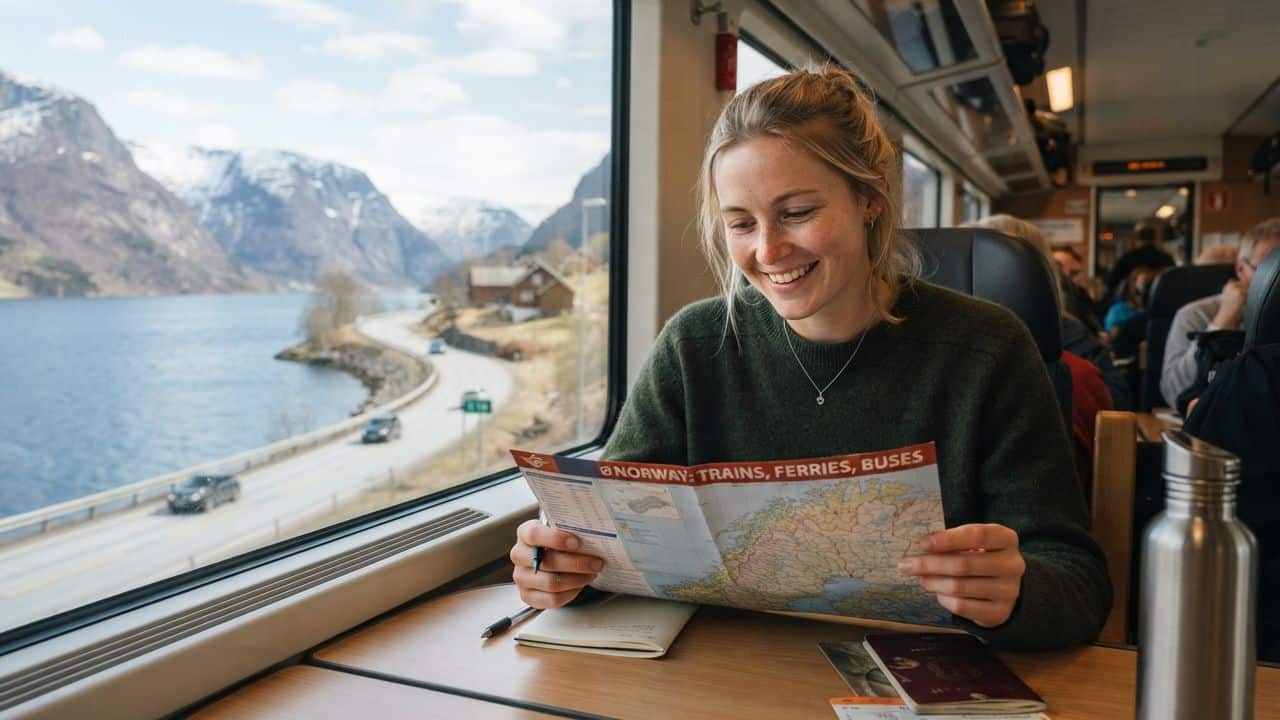
How to Get Around Norway
Norway is a country where the journey can be just as memorable as the destination. From railway lines crossing high mountain plateaus to ferries gliding between fjords and winding roads beside waterfalls, getting around Norway is part of the travel experience.
The best way to travel depends heavily on where you are going. Trains are excellent for major city-to-city journeys, buses fill many gaps in the rail network, ferries are essential in the fjord regions and along the coast, while a rental car offers the greatest freedom for remote areas and scenic road trips.
Norway’s public transport system is also easier to navigate than its geography might suggest. The national journey planner, Entur, combines information across trains, buses, ferries, trams and other public transport, making it a useful starting point when planning a trip.
Whether you are planning a short city break or a two-week Norway road trip, understanding the different transport options can help you save time, control costs and see more of the country’s spectacular landscapes.
Norway’s Main Transportation Options
Norway has a well-developed transport network, but its long distances, mountains, fjords and scattered communities mean that no single form of transport covers everything.
| Transport | Best for | Typical advantage | Main drawback |
|---|---|---|---|
| Train | Major cities and long-distance journeys | Comfortable and scenic | Limited network in remote areas |
| Bus | Smaller towns and regional connections | Reaches places trains do not | Journeys can be long |
| Ferry | Fjords, islands and coastal routes | Often essential rather than optional | Schedules vary by route |
| Rental car | Road trips and remote destinations | Maximum flexibility | Fuel, tolls and parking add up |
| Domestic flight | Very long distances | Saves considerable time | Less scenic and often more expensive |
| Local transit | Cities and towns | Convenient and frequent | Mostly useful within urban areas |
A mixed approach is usually the smartest way to travel around Norway. For example, you could take a train from Oslo to Bergen, use buses and ferries around the fjords, and rent a car for a few days to explore more remote locations.
Travelling by Train in Norway
When to Choose the Train
Norwegian trains are one of the best options for travelling between the country’s major population centres. They are particularly useful for journeys such as Oslo to Bergen, Oslo to Trondheim, Oslo to Stavanger and Oslo to Bodø.
The famous Bergen Line is a highlight in its own right. The journey from Oslo to Bergen takes roughly 6½ hours on the fastest services and crosses the Hardangervidda mountain plateau, passing through destinations such as Geilo and Voss.
The railway is also a strong choice when you want to enjoy the scenery without concentrating on the road. You can sit back, watch mountains and valleys pass by and arrive without dealing with parking or driving.
Other notable journeys include:
- Oslo–Bergen: One of Norway’s classic scenic railway journeys.
- Oslo–Trondheim: A convenient route into central Norway.
- Oslo–Bodø: A much longer journey combining the Dovre Line and Nordland Line.
- Oslo–Kristiansand: A useful connection to southern Norway.
- Oslo–Geilo: An easy way to reach a mountain destination without driving.
The Oslo–Bodø journey can take around 19 hours at its fastest and involves at least one change, but it provides a dramatic way to travel towards the Arctic Circle.
Train Ticket Prices
Norwegian train fares vary significantly according to the route, travel date, demand and ticket type. As a rough planning figure, short and medium-distance train trips might cost around NOK 200–600, while longer journeys can range from roughly NOK 400 to NOK 1,500 or more.
These are estimates rather than fixed fares. For example, Vy currently advertises selected fares from NOK 359 on the Bergen Line, while actual prices depend on the departure and availability.
Booking early can make a substantial difference. Vy’s Lowfare tickets are limited and are specifically intended to provide its cheapest option, but they are non-refundable and cannot normally be changed.
For flexibility, a more expensive ticket can be worthwhile if your itinerary is likely to change.
How to Book Norwegian Trains
The easiest starting point is Entur, Norway’s national travel planner. It allows you to search journeys and buy train tickets, and its planner can combine different forms of public transport into one itinerary.
You can also book directly through Vy for many train services. Vy advises travellers to use authorised sales channels and warns that some third-party ticket sellers are not authorised to sell its tickets.
A good strategy is:
- Search your journey on Entur.
- Compare departure times and ticket prices.
- Check whether an inexpensive advance fare is available.
- Book early for popular summer departures.
- Keep your booking details accessible on your phone.
Travelling by Bus in Norway
Why Buses Matter
Buses are an important part of Norway’s transport network because railways cannot reach every community.
They are particularly useful in rural areas, mountain regions and places where a train journey would require a lengthy detour. Long-distance buses can also compete with trains on certain routes.
For example, Entur currently lists both train and bus options between Oslo and Kristiansand. The fastest direct bus journey is around four hours, compared with approximately 4 hours 26 minutes by train.
Between Oslo and Stavanger, the fastest direct bus journey is also broadly comparable with the train, at around eight hours.
Typical Bus Costs
As a broad guide, expect:
- Short regional journeys: around NOK 50–200
- Medium-distance journeys: around NOK 150–500
- Long-distance coaches: around NOK 300–800+
Prices vary by operator, route and booking time, so use the current fare shown when you plan your journey.
Buses can be especially good value for travellers who are not hiring a car. They also let you reach destinations that would otherwise require complicated combinations of transport.
Taking Ferries in Norway
Ferries Are Part of the Road Network
In Norway, ferries are not simply tourist attractions. Many are an integral part of the country’s transport infrastructure.
Ferries connect communities separated by fjords, islands and stretches of coastline. If you are driving through western Norway, you may find yourself using several ferries during a single day.
This is especially common around destinations such as the Sognefjord, Hardangerfjord, Sunnmøre and northern coastal regions.
Some ferry journeys are short crossings of only a few minutes, while others form substantial parts of scenic road trips.
The Norwegian Scenic Route Helgelandskysten, for example, includes six ferry crossings, illustrating how closely ferries and road travel can be connected in Norway.
How Much Do Norwegian Ferries Cost?
Ferry prices depend on the specific connection, vehicle size, passenger status and payment method.
For drivers, many ferries use automatic number-plate or AutoPASS-based payment systems. The official AutoPASS ferry system states that most participating ferries are covered by the scheme.
For 2026, private customers with an AutoPASS for ferry prepayment agreement can receive a 50% discount on eligible ferry journeys, while a valid AutoPASS tag without the additional ferry agreement gives a 10% discount.
Visitors who rent a car should ask the rental company how tolls and ferry charges are handled before setting off. The vehicle may already have an electronic toll arrangement.
If you do not have an AutoPASS arrangement, FerryPay allows you to register a vehicle and payment card so eligible ferry journeys can be charged automatically.
Always check the exact ferry fare before travelling because prices can change and summer rates apply on some routes.
Do You Need to Reserve a Ferry?
For many ordinary domestic car ferries, you generally do not make a traditional seat-style reservation. You arrive at the terminal, join the appropriate queue and board when space is available.
However, don’t assume every boat works this way. Longer passenger services, express boats and some tourist-oriented cruises can have different ticketing procedures.
Check the operator’s current information if your journey depends on a particular departure.
Renting a Car in Norway
When Driving Makes Sense
A rental car is often the best choice when your main goal is to explore Norway’s countryside rather than simply travel between cities.
Driving gives you the freedom to:
- Stop at viewpoints whenever you want.
- Visit small villages.
- Reach trailheads that are poorly served by public transport.
- Carry hiking equipment easily.
- Change your route when the weather changes.
- Explore several fjords in one trip.
A car becomes particularly valuable in areas such as the Lofoten Islands, parts of western Norway, the fjord country and northern Norway.
However, driving in Norway is not necessarily the fastest way to cover long distances. Mountain roads can be narrow and winding, and ferry crossings may add waiting time.
The Cost of Driving
A rental car’s advertised daily rate is only part of the budget.
Consider:
- Rental fee
- Fuel or charging
- Tolls
- Ferry charges
- Parking
- Insurance and excess
- Potential one-way rental fees
For a basic rental, a useful planning estimate might be NOK 500–1,200+ per day, with larger vehicles and peak-season rentals potentially costing considerably more.
Fuel and toll expenses can then add significantly to the total.
Electric cars are common in Norway, but do not assume every remote destination has convenient charging. If you plan a mountain or northern road trip, check charging locations before leaving the main towns.
Norway’s Best Scenic Transport Journeys
One of the biggest advantages of travelling around Norway is that several transport routes are attractions in their own right.
Oslo to Bergen by Train
The Bergen Line is arguably the classic Norwegian railway journey. It crosses the Hardangervidda plateau and travels through changing landscapes between eastern and western Norway.
For travellers who want spectacular scenery without renting a car, this is one of the easiest choices.
Bergen and the Fjords by Ferry
Bergen is a convenient base for exploring western Norway. From here, ferries and express boats can take you deeper into the fjord region.
A combination of train, bus and boat can work particularly well if you want to experience the fjords without driving.
Helgelandskysten by Car and Ferry
The Helgelandskysten Scenic Route is ideal for a slower road trip. It combines coastal roads, mountains, islands and six ferry crossings.
This is not a route to rush. Allow several days if you want time for photography, hiking and spontaneous stops.
Aurlandsfjellet by Car
The Aurlandsfjellet route is famous for its dramatic change in scenery, from fjord-side landscapes to high mountain terrain. The route includes the Stegastein viewpoint and the spectacular Aurlandsfjellet mountain road.
Check seasonal opening conditions before travelling, as some mountain roads are closed during winter.
Norway’s 18 Scenic Routes
For travellers planning a road trip, Norway’s official Norwegian Scenic Routes are an excellent source of inspiration.
There are 18 designated routes covering about 2,240 kilometres. They run through coastal landscapes, fjords, mountains and waterfalls, with specially designed viewpoints, rest areas and artworks along the way.
Some routes worth considering include:
- Atlantic Road
- Lofoten
- Senja
- Geiranger–Trollstigen
- Hardanger
- Aurlandsfjellet
- Sognefjellet
- Helgelandskysten
- Rondane
- Varanger
Be realistic about driving times. Some Scenic Routes are narrow and winding, and certain sections can become busy during the summer. Some routes are also closed in winter.
The route may look short on a map, but the combination of slow roads, photo stops and ferry crossings can turn a few-hour drive into a full-day experience.
Practical Tips for Getting Around Norway
Use Entur Before Booking Everything Separately
Entur is one of the most useful tools for Norway travel because it brings together different transport modes. Its journey planner can search combinations of train, bus, ferry, tram and other services.
This is particularly helpful for complicated journeys such as:
Train → bus → ferry → bus
Instead of checking every operator separately, start with the complete journey.
Book Popular Trains Early
If you are travelling in summer, around Christmas or during other busy periods, book long-distance trains as soon as your itinerary is reasonably firm.
Early booking can unlock Lowfare tickets on Vy services.
Allow Extra Time for Connections
Norway’s geography can make connections less predictable than they look on a map.
A ferry may be delayed by weather or operational issues. A mountain road can take longer than expected. A bus connection may be affected by traffic.
If a missed connection would ruin your day, avoid planning an extremely tight transfer.
Check Seasonal Road Conditions
Mountain roads can have seasonal closures, and weather conditions can change quickly.
Before a road trip, check current traffic and road information, particularly if you are travelling outside the main summer season.
Don’t Underestimate Distances
Norway looks deceptively manageable on a map. A route that appears relatively short may involve fjord crossings, mountain roads and frequent stops.
Instead of asking, “How many kilometres is this?”, ask, “How many hours will this realistically take?”
A Simple Transport Strategy for Different Trips
| Type of trip | Recommended transport |
|---|---|
| Oslo city break | Walking + local public transport |
| Oslo to Bergen | Train |
| Bergen fjord trip | Train + ferry/bus |
| Oslo to Trondheim | Train |
| Lofoten | Rental car + ferries/buses |
| Western Norway road trip | Rental car + ferries |
| Northern Norway | Combination of flights, buses and rental car |
| Budget trip | Trains + buses + selected ferries |
| Photography road trip | Rental car |
| Winter city-to-city journey | Train or bus, depending on route |
Final Thoughts: What Is the Best Way to Get Around Norway?
There is no single best way to get around Norway. The right choice depends on your destination, travel style and how much flexibility you want.
Choose trains for comfortable, scenic journeys between major cities.
Choose buses when you are travelling beyond the railway network or looking for an alternative to trains.
Choose ferries when exploring fjord and coastal regions, because they are often an essential part of the transport network.
Choose a rental car when your priority is flexibility, remote destinations and scenic road trips.
For many visitors, the ideal solution is a combination of all four.
Start by using Entur to understand the public transport possibilities, then compare the cost and convenience of renting a car for the parts of your itinerary where flexibility matters most. For trains, booking early can help you find cheaper fares, while drivers should understand how tolls and ferry payments work before picking up a rental vehicle.
Most importantly, give yourself more time than a map suggests. Norway’s fjords, mountains, islands and scenic roads reward slow travel. The goal is not simply to get from one city to another—it is to enjoy the spectacular journey in between.
Quick Takeaway
If you are still unsure which transport option to choose, use this simple rule:
- Major cities: take the train.
- Smaller towns: check the bus.
- Fjords and islands: look for a ferry.
- Remote areas: consider renting a car.
- Scenic road trips: drive slowly and allow extra time.
- Complex journeys: start with Entur.
- Busy-season train travel: book early.
- Rental-car trips: budget for tolls, ferries, fuel and parking.
With a little planning, getting around Norway can become one of the highlights of the trip itself.